
In India, the company serves customers such as stock exchanges, brokers, non-banking financial companies, financial services and insurance, IT and IT-enabled services.

The Bill says that the central government, in consultation with the Data Protection Authority, can direct any data fiduciary or data processor to provide non-personal data to enable better targeting of delivery of services. The government can also ask data processors to provide data for formulation of evidence-based policies for its own use.

Recently listed companies scored 54, compared to 58 for the BSE100 firms and 61 for entities in the Sensex pack. The report noted that issues remain in IPO companies in which there seems to be a need to institutionalise governance practices.

'If Indians are to be truly protected, Parliament must review and address these dangerous provisions before they become law.'

In the worst-case scenario, it will be next to impossible for tech companies like Amazon and Google to run any service that requires user biometrics.

In platforms, such as Twitter, Facebook, TikTok, Helo, and ShareChat, mediators have been asked to put in more hours to ensure that no communal or fake news spread.

Ghost beneficiaries aren't the only kind of issue companies face during a period of unprecedented CSR spending, touching nearly Rs 12,000 crore in 2018-19. Frauds related to procurement, construction, and end-use of funds have had companies engaging forensic auditors to keep tabs on how money is spent, revealed conversations with those involved in such investigations. Firms are also increasingly strengthening their own capabilities to better implement their programmes.

People familiar with the proceedings said independent cybersecurity experts from a private consulting firm, technology lawyers, government officials and WhatsApp representatives were asked questions about the Pegasus spyware and the larger issues surrounding surveillance, hacking and remedial measures.

The biggest spend (Rs 4,406 crore) was for Schedule VII (II), which involves "promoting education, including special education and employment enhancing vocation skills, especially among children, women, elderly and the differently abled and livelihood enhancement projects". The FY19 spend was 17.2 per cent higher than Rs 1,0128.3 crore spent during the previous year.
If the Personal Data Protection Bill gets passed in its present form, a new class of companies and entities could emerge. The sole job of these new entities would be to manage the consent for data usage of a user.Banks, healthcare firms and fintech companies, among others, fear that sharing non-personal data with the government may hurt business interests. Banks also fear the threat of data misuse.

Indian funds did better than Asian ones in only four of the 10 months -- till October. Despite much market optimism, presumably around policy interventions and guided by buoyant flows, India's macro backdrop may be turning for the worse.

The biggest fear many of the e-commerce firms have is the possible requirement to change business models overnight, which would drastically increase costs as well as disrupt businesses.
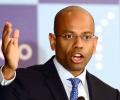
Oyo has recently undergone large-scale corporate restructuring, setting up several subsidiaries and bifurcating operations globally.

Fintech giant Paytm claimed it is selling more FASTags than all the banks put together on a daily basis.

Lower cost and easier termination may well be among the reasons that companies seek to have employees on contract. The share of employees on contract has increased to 57.3 per cent of the total workforce this year as compared to 53.7 per cent in the previous year.

The lack of a strong diversity policy on the part of companies, a limited pool of women candidates as well as socio-cultural factors contribute to their low numbers.

In a communication to the ministry of electronics and information technology, the messaging service said it was committed to protecting the privacy of its over 400 million users in India.

This episode highlights that the country's surveillance systems are not robust enough to ward off and prevent such attacks in the future.
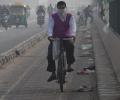
The delivery staff who drop off packages for online retail giants or food or ferry passengers around the city in their taxis are among the worst affected by the capital's foul air.

Recently, several Twitter users began migrating to the social networking platform after a protest that began with Supreme Court lawyer Sanjay Hegde's Twitter account suspension, and moved on to a larger conversation about Twitter's policies being allegedly anti-Dalit and certain castes and religion.
 © 2026 Rediff.com - Advertise with us - Disclaimer - Privacy Policy - Sitemap - Feedback - About us - Terms of use - Grievances